

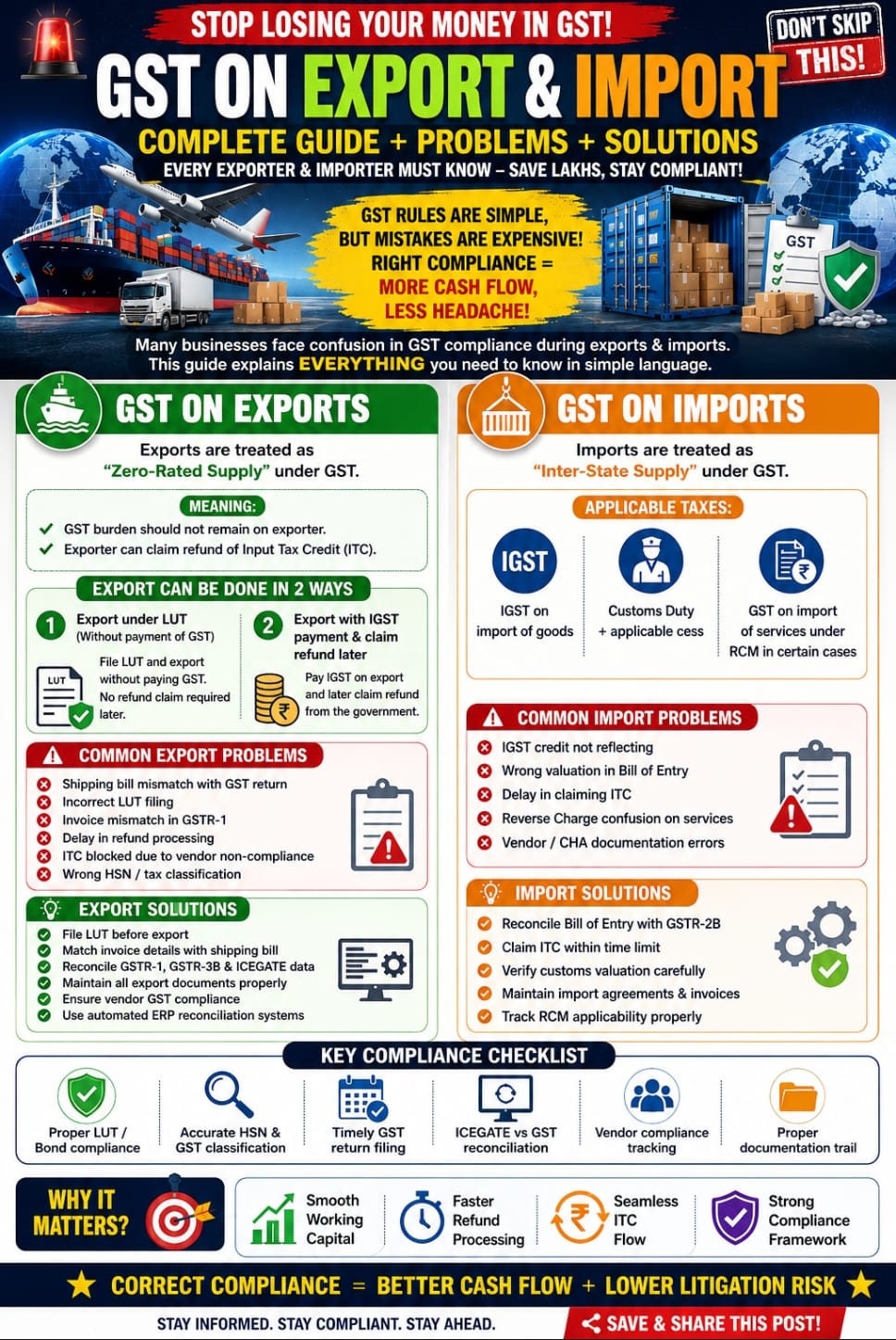
GST on Export & Import: Biggest Mistakes Businesses Make @
International trade can grow your business rapidly, but one GST mistake in exports or imports can block refunds, freeze ITC, increase working capital pressure, and even bring notices or penalties. Many businesses lose money not because of low sales, but because of poor GST compliance.
If you deal in exports or imports, understanding GST rules is extremely important. This guide explains the meaning of GST on exports and imports, common mistakes businesses make, and the best practical solutions to stay compliant and protect cash flow.
@ GST on Exports
Under GST law, exports are treated as “Zero-Rated Supply.”
This means exports are taxable supplies, but the exporter should not ultimately bear the GST burden.
The main benefit is that exporters can claim a refund of Input Tax Credit (ITC) or GST paid during export.
✅ Two Ways to Export Under GST
1️⃣ Export Under LUT (Without Payment of GST)
Businesses can export goods or services by filing an LUT (Letter of Undertaking).
In this method:
- No GST is paid on export invoices
- Export is made without payment of IGST
- Refund process becomes easier
- Working capital blockage reduces
This option is preferred by many exporters because funds do not get stuck in refund claims.
2️⃣ Export With IGST Payment and Claim Refund Later
In this method:
- IGST is paid at the time of export
- Refund is claimed later from the government
Although legal and commonly used, delayed refunds can affect business cash flow badly.
@ Common GST Problems in Exports
# Shipping Bill Mismatch
If invoice details in GST returns do not match shipping bill details, refund processing may stop automatically.
Even small differences in:
- Invoice number
- Invoice date
- Port code
- Taxable value
can create refund issues.
# Incorrect LUT Filing
Many businesses:
- File LUT late
- Use expired LUT
- Make errors in filing
This can result in compliance notices or denial of export benefits.
# Invoice Mismatch in GSTR-1
Incorrect reporting in GSTR-1 creates problems in:
- Refund claims
- GST reconciliation
- ICEGATE validation
# Refund Delays
Refund delays are one of the biggest issues for exporters.
This impacts:
- Working capital
- Vendor payments
- Business operations
# ITC Blocked Due to Vendor Non-Compliance
If suppliers fail to file returns correctly, your ITC may get blocked even if purchases are genuine.
# Wrong HSN or Tax Classification
Incorrect HSN codes or tax classifications can lead to:
- GST notices
- Penalties
- Refund rejection
- Interest liability
✅ Solutions for Export Businesses
To avoid GST troubles during exports:
✔ File LUT before starting exports
✔ Match invoices with shipping bills carefully
✔ Reconcile GSTR-1, GSTR-3B and ICEGATE data regularly
✔ Maintain proper export documentation
✔ Track vendor GST compliance
✔ Use automated accounting or ERP reconciliation systems
Good compliance reduces refund delays and improves cash flow stability.
# GST on Imports
Under GST, imports are treated as Inter-State Supply.
Therefore, IGST applies on imported goods and services.
Apart from GST, importers may also need to pay:
- Customs Duty
- Social Welfare Surcharge
- Applicable cess
# Taxes Applicable on Imports
# IGST on Import of Goods
IGST is charged when goods enter India from another country.
Usually, importers can claim ITC of the IGST paid, subject to compliance conditions.
???? Customs Duty and Applicable Cess
Customs duty is levied separately by Customs authorities and becomes part of import cost.
???? GST on Import of Services Under RCM
In many cases, importing services from foreign companies attracts GST under Reverse Charge Mechanism (RCM).
Examples include:
- Foreign software subscriptions
- Online advertising services
- Foreign consultancy services
# Common Import GST Problems
# IGST Credit Not Reflecting
Many businesses face issues where import IGST does not appear properly in GST records or reconciliation statements.
# Wrong Valuation in Bill of Entry
Incorrect valuation can result in:
- Higher tax liability
- Customs disputes
- Penalties
# Delay in Claiming ITC
Businesses often miss ITC deadlines due to poor reconciliation practices.
# Reverse Charge Confusion
RCM applicability on imported services creates confusion for many taxpayers.
Wrong treatment may lead to notices and interest liability.
# Vendor or CHA Documentation Errors
Mistakes by:
- Customs brokers
- Freight forwarders
- CHA agents
- Vendors
can create major compliance problems.
✅ Solutions for Import Businesses
✔ Reconcile Bill of Entry with GSTR-2B
✔ Claim ITC within legal time limits
✔ Verify customs valuation carefully
✔ Maintain all agreements and import invoices
✔ Track RCM applicability properly
Strong documentation is extremely important in import transactions.
# Important GST Compliance Checklist
Every exporter and importer should regularly check:
✅ Proper LUT or bond compliance
✅ Accurate HSN and GST classification
✅ Timely GST return filing
✅ ICEGATE vs GST reconciliation
✅ Vendor compliance tracking
✅ Proper documentation trail
✅ ITC reconciliation
✅ Bill of Entry verification
# Why Correct GST Compliance Matters
Correct GST management is not just about paying taxes.
It directly impacts:
# Better Cash Flow
Faster refunds and proper ITC reduce financial pressure.
# Faster Refund Processing
Accurate filing helps avoid refund rejection and delays.
# Smooth ITC Flow
Proper reconciliation protects valuable input tax credit.
???? Lower Litigation Risk
Correct compliance reduces chances of notices, penalties, and legal disputes.
# Final Conclusion
Export and import businesses can grow rapidly with proper GST planning. However, poor compliance can create serious financial problems.
Businesses should focus on:
- Accurate documentation
- Timely GST filing
- Vendor compliance monitoring
- Proper reconciliation
- Correct HSN classification
A strong GST system not only protects your business from notices and penalties but also improves profitability and working capital management.
# Remember:
Correct GST Compliance = Better Cash Flow + Lower Litigation Risk ##
Comments (0)
Abhi tak koi comment nahi. Pehle comment karein!