

# GST on Solar Projects: Why Only 8.9% Applies, Not 18%
# Introduction
Many businesses working in solar EPC (Engineering, Procurement, and Construction) projects often face a critical question:
# Should GST be paid at 18% on the entire project value?
# Or does the law allow a lower effective rate?
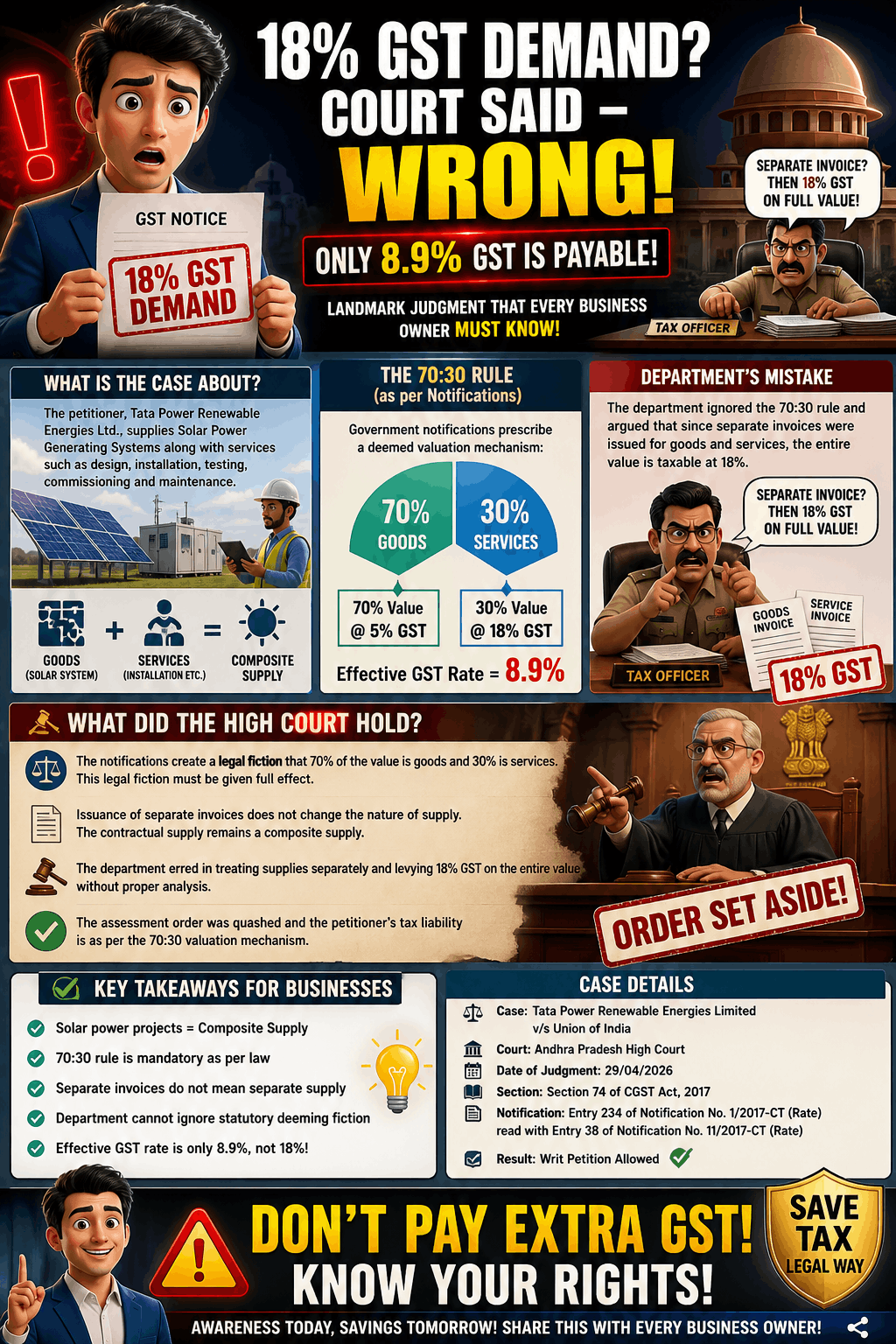
A recent ruling by the Andhra Pradesh High Court has clarified this confusion and confirmed that GST on solar power generating systems should be calculated using the 70:30 valuation rule, resulting in an effective rate of 8.9%.
Let’s break this down in a simple and practical way.
@ What Was the Issue?
In this case, a solar company:
- Supplied solar panels (goods)
- Provided installation and related services
# The company treated it as a composite supply and applied GST as per the 70:30 rule.
However, the GST department argued:
- Separate invoices were issued for goods and services
- Therefore, the entire supply should be taxed at 18%
This led to a major tax demand and litigation.
@ Understanding the 70:30 GST Rule
Under GST notifications, solar power generating systems follow a deemed valuation mechanism:
- 70% of total value = Goods → GST @ 5%
- 30% of total value = Services → GST @ 18%
# Example Calculation
If total contract value = ₹100:
- Goods: ₹70 × 5% = ₹3.5
- Services: ₹30 × 18% = ₹5.4
# Total GST = ₹8.9 (Effective Rate = 8.9%)
$ What Did the Court Decide?
The Andhra Pradesh High Court gave a clear and important ruling:
✔️ 1. 70:30 Rule is Mandatory
The valuation mechanism prescribed in GST notifications must be followed.
✔️ 2. Separate Invoices Do Not Matter
Even if goods and services are billed separately, the supply remains composite in nature.
✔️ 3. Legal Fiction Must Be Applied
The law assumes (deems) that:
- 70% is goods
- 30% is services
# This applies regardless of actual billing structure.
✔️ 4. 18% on Entire Value is Incorrect
The department cannot arbitrarily apply 18% on the full contract value.
# Key Takeaways for Businesses
# If You Are in Solar EPC or Turnkey Projects:
- Always apply the 70:30 GST rule
- Don’t worry if invoices are separate
- Ensure proper documentation of composite contracts
# If You Receive a GST Notice:
- Check if the department has wrongly applied 18%
- Refer to this judgment for defense
- Use the 70:30 rule as a legal backing
# Practical Impact
This judgment is a big relief for:
- Solar project contractors
- EPC companies
- Renewable energy businesses
???? It ensures that businesses are not overburdened with unnecessary GST liability.
# Common Mistakes to Avoid
# Applying 18% GST on full project value
# Ignoring composite supply concept
# Assuming separate invoices mean separate taxation
$ Conclusion
The law is now clear:
???? Solar power generating systems are taxable using the 70:30 rule
???? Resulting in an effective GST rate of 8.9%
The court has reinforced that substance of the contract matters more than the format of invoicing.
# Final Thought
???? “If you don’t apply the 70:30 rule correctly, you may end up paying double GST.”


Comments (0)
Abhi tak koi comment nahi. Pehle comment karein!