

TCS Section 394 Explained – Complete Guide on New Income Tax Law
Introduction
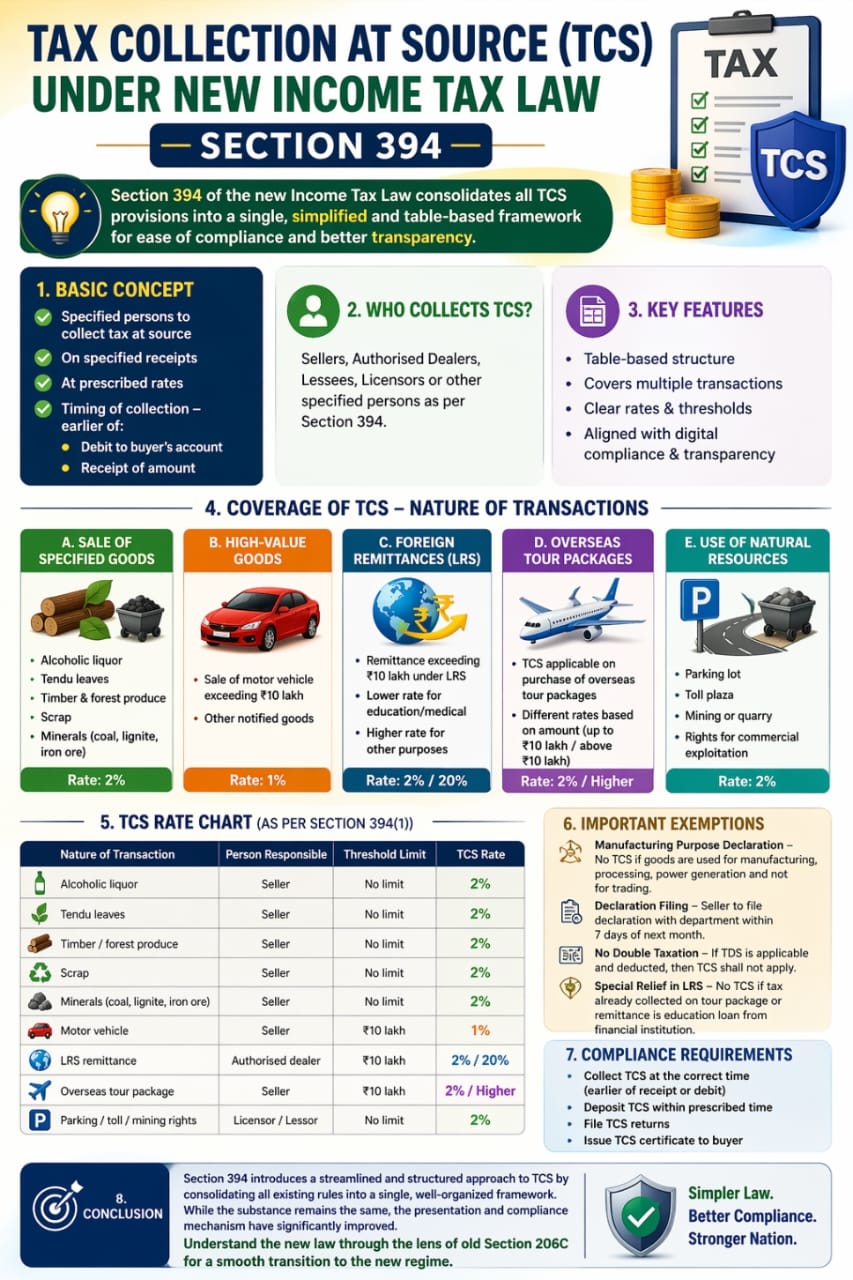
The new Income Tax framework has introduced Section 394, which governs Tax Collection at Source (TCS) in a simplified and structured manner. Earlier, TCS provisions were covered under Section 206C, but now all rules are consolidated into a single section to improve clarity, compliance, and ease of understanding.
This change is part of the government’s effort toward simplification, digitisation, and better tax tracking.
What is TCS under Section 394?
TCS (Tax Collection at Source) means that a seller or specified person collects tax from the buyer at the time of sale or receipt of payment and deposits it with the government.
When is TCS collected?
TCS is collected at the earlier of:
- Debit to buyer’s account, or
- Receipt of payment
Structure of Section 394
The new section presents TCS provisions in a table-based format, making it easier to understand:
- Nature of transaction
- Person responsible for collection
- Applicable TCS rate
Transactions Covered under Section 394
1. Sale of Specified Goods
TCS applies on sale of:
- Alcoholic liquor
- Tendu leaves
- Timber and forest produce
- Scrap
- Minerals like coal, lignite, and iron ore
???? TCS Rate: Generally 2%
2. High-Value Transactions
- Sale of motor vehicles exceeding ₹10 lakh
???? TCS Rate: 1%
3. Foreign Remittance (LRS)
- Remittance exceeding ₹10 lakh under Liberalised Remittance Scheme
???? Rates:
- Lower for education/medical purposes
- Higher (up to 20%) for others
4. Overseas Tour Packages
- Purchase of international tour packages
???? Different rates based on amount (below or above ₹10 lakh)
5. Use of Natural Resources
TCS applies when rights are given for:
- Parking lots
- Toll plazas
- Mining or quarrying
???? TCS Rate: 2%
TCS Rate Chart (Summary)
TransactionLimitRateScrap, Timber, MineralsNo limit2%Motor Vehicle₹10 lakh1%LRS Remittance₹10 lakh2% / 20%Tour Package₹10 lakh2% / higherToll / Parking / MiningNo limit2%Important Exemptions
1. Manufacturing Purpose
No TCS is applicable if:
- Buyer is a resident
- Goods are used for manufacturing, processing, or power generation
- Not used for trading
2. Declaration Requirement
- Buyer must provide a declaration
- Seller must submit it to the department within 7 days of next month
3. No Double Taxation
- If TDS is already deducted on a transaction
- ???? TCS will not apply
4. LRS Relief
No TCS in certain cases:
- Education loan from financial institutions
- Tax already collected on overseas tour packages
Compliance Requirements
Persons responsible for TCS must:
- Collect tax at correct time
- Deposit TCS within due dates
- File TCS returns
- Issue TCS certificates to buyers
Key Benefits of Section 394
- Simplified law structure
- Single section for all TCS provisions
- Better compliance and transparency
- Easier interpretation for professionals
Conclusion
Section 394 is a major reform in TCS provisions, bringing all rules into a single, organised framework. While the core concept remains unchanged, the presentation and compliance process are now much simpler and more efficient.
For businesses and professionals, understanding this section is crucial to ensure proper tax collection, timely compliance, and avoidance of penalties.
Tags
TCS Section 394, TCS New Law, Income Tax Update, TCS Rates, Tax Collection at Source, India Tax Law, TCS Compliance, Finance India
Comments (0)
Abhi tak koi comment nahi. Pehle comment karein!